
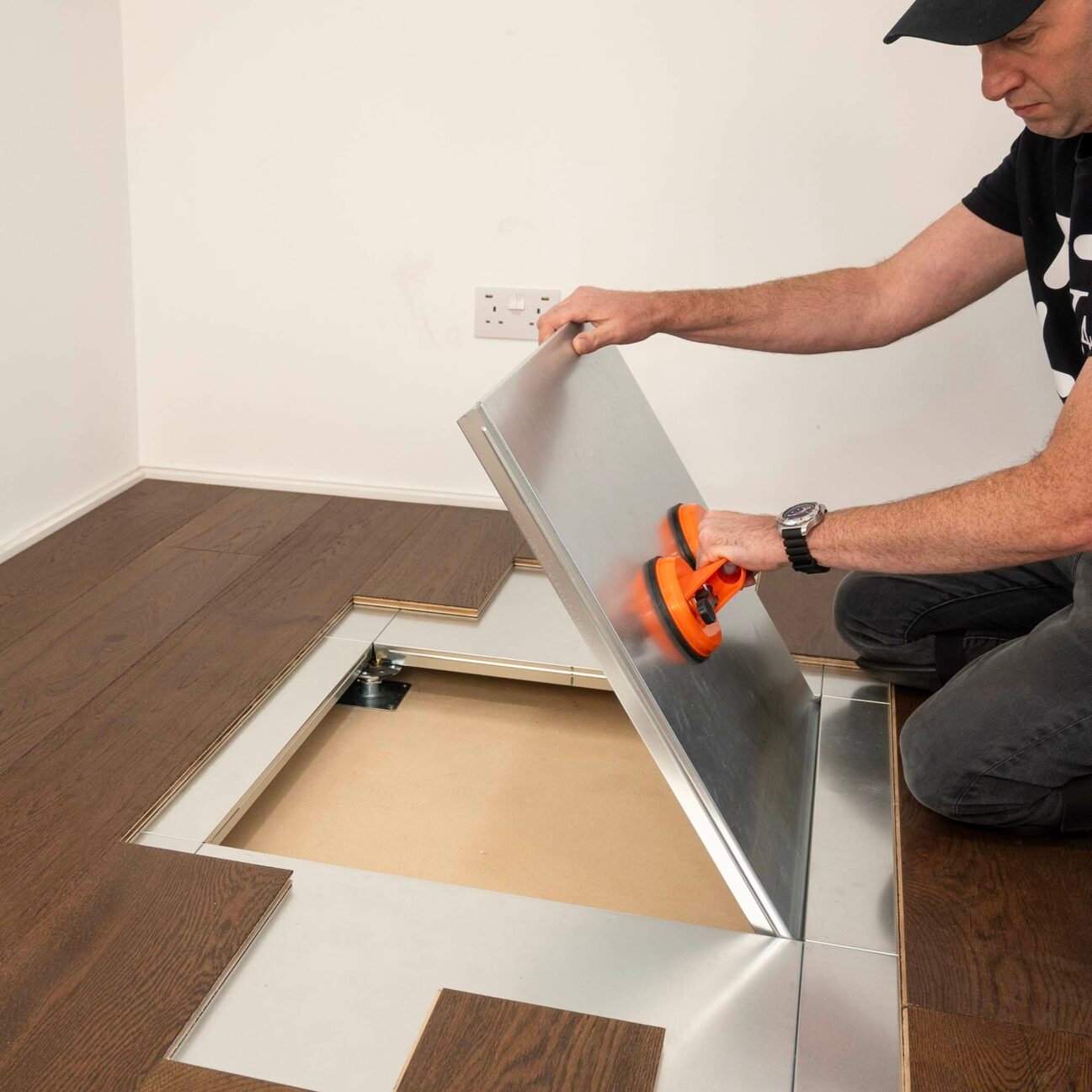
Raised access floors are widely used in commercial offices as they provide a flexible way to manage and maintain building services beneath the finished floor.
Power, data, heating, ventilation and other services can all be located within the floor void, with removable access floor panels providing access when maintenance or changes are required.
However, the challenge comes when the finished flooring installed above the raised access floor makes those panels and voids difficult to reach.
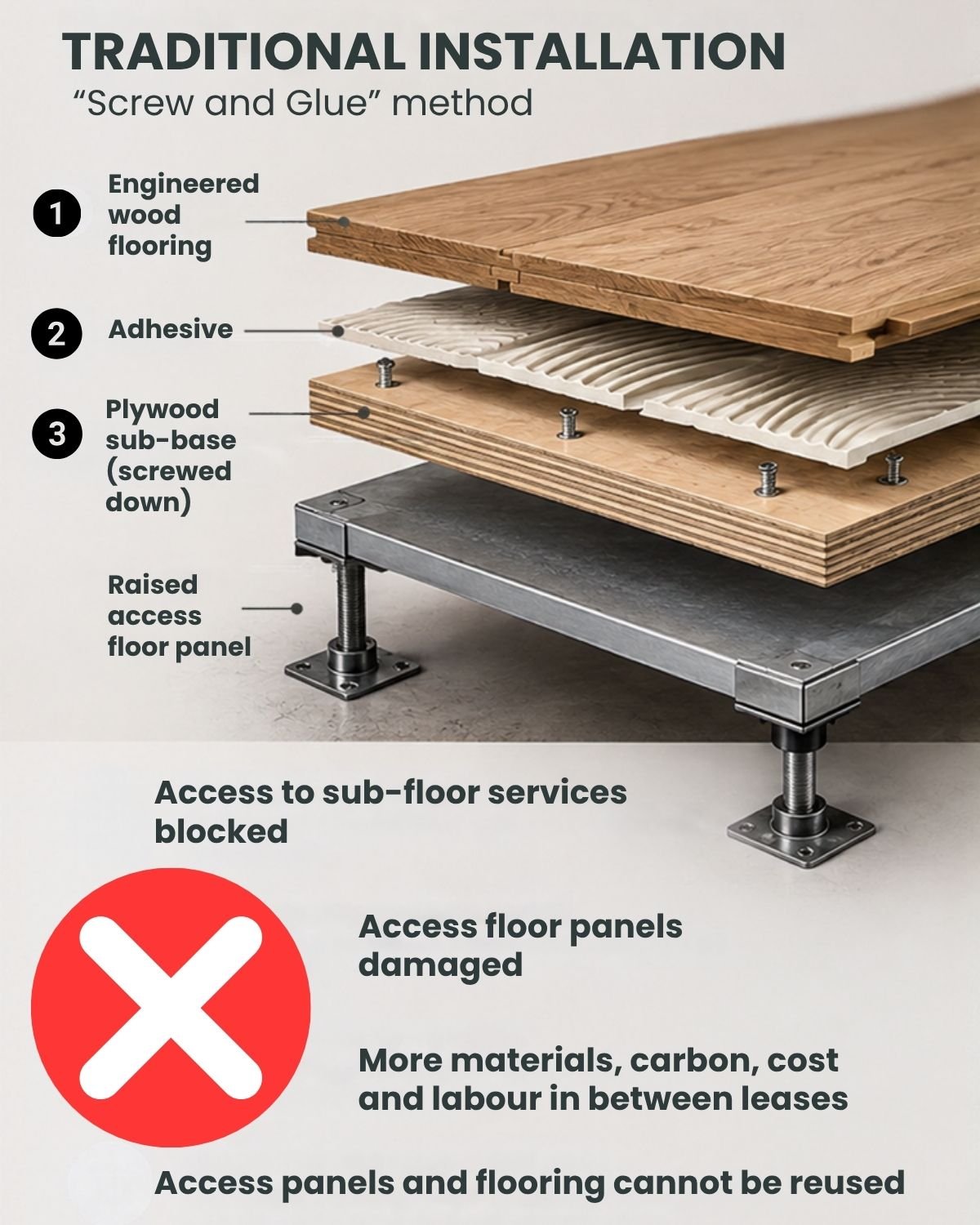
Traditional wood flooring installation can involve fixing a plywood base to the metal raised access floor before gluing the engineered wood flooring into place. This makes future access to the floor void impossible.
Plus, this permanent fixing method damages and contaminates the access floor panels, making reuse of the engineered wood, plywood base and access floor impossible.
Magnetic wood flooring provides an alternative.
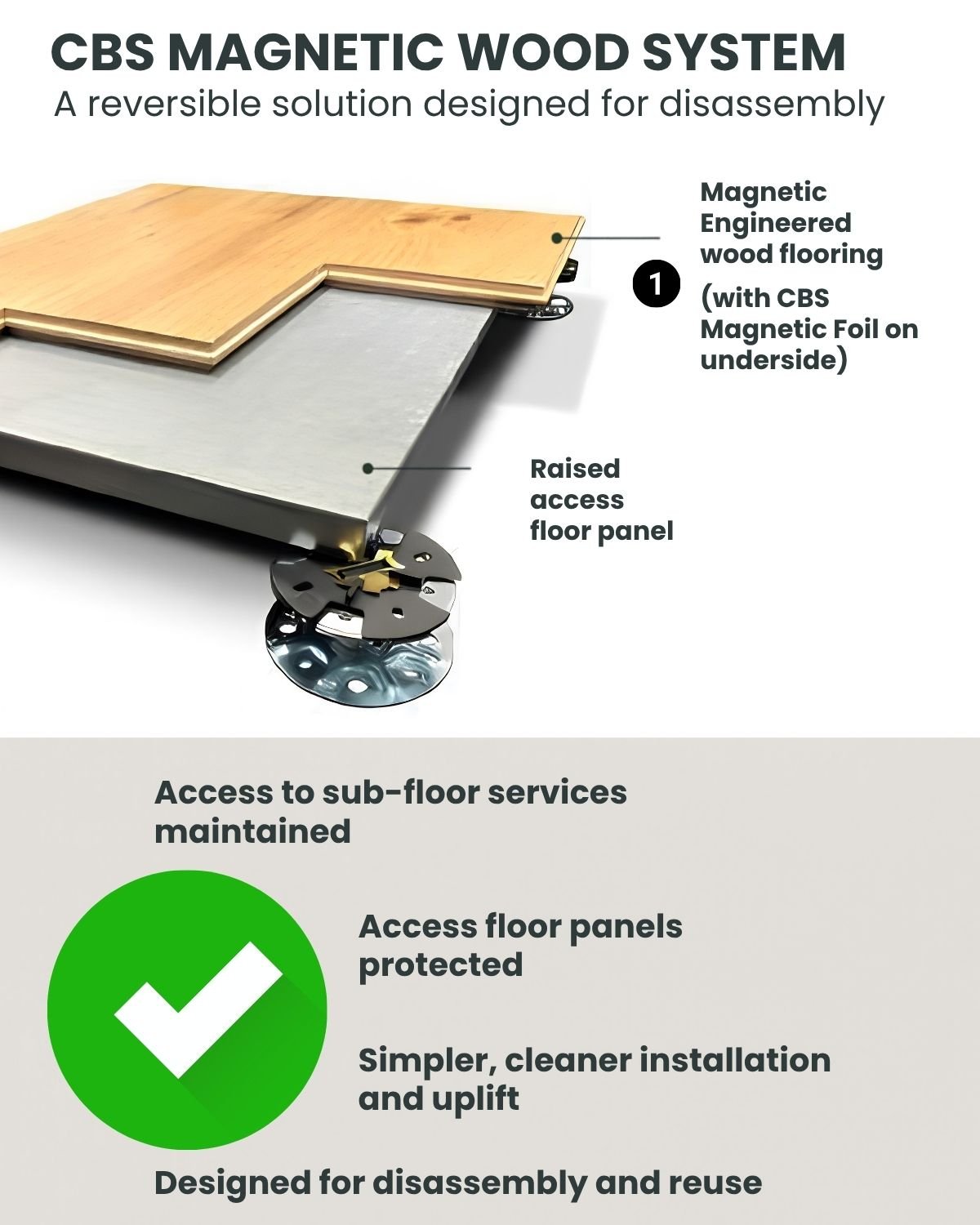
By using a reversible magnetic connection between the engineered wood flooring and a suitable metal raised access floor or magnetically receptive acoustic underlay, the flooring can be securely installed whilst retaining the ability to access selected areas of the floor below, ensuring clean and simple design for disassembly.
The CBS Magnetic Wood System offers significant benefits over other magnetic wood flooring systems, including its patented IOBAC Dual-Grip™ film technology which provides an additional dimension of hold between the magnetic wood flooring and sub-floor.
Our know-how enables tongue-and-groove engineered wood flooring to be magnetised, along with practical solutions for creating and identifying magnetic wood flooring access planks. As we explore in the article below, this provides more efficient access to sub-floor services whilst maintaining a more secure tongue-and-groove installation across the majority of the floor.
How does magnetic wood flooring provide access to raised floor services?
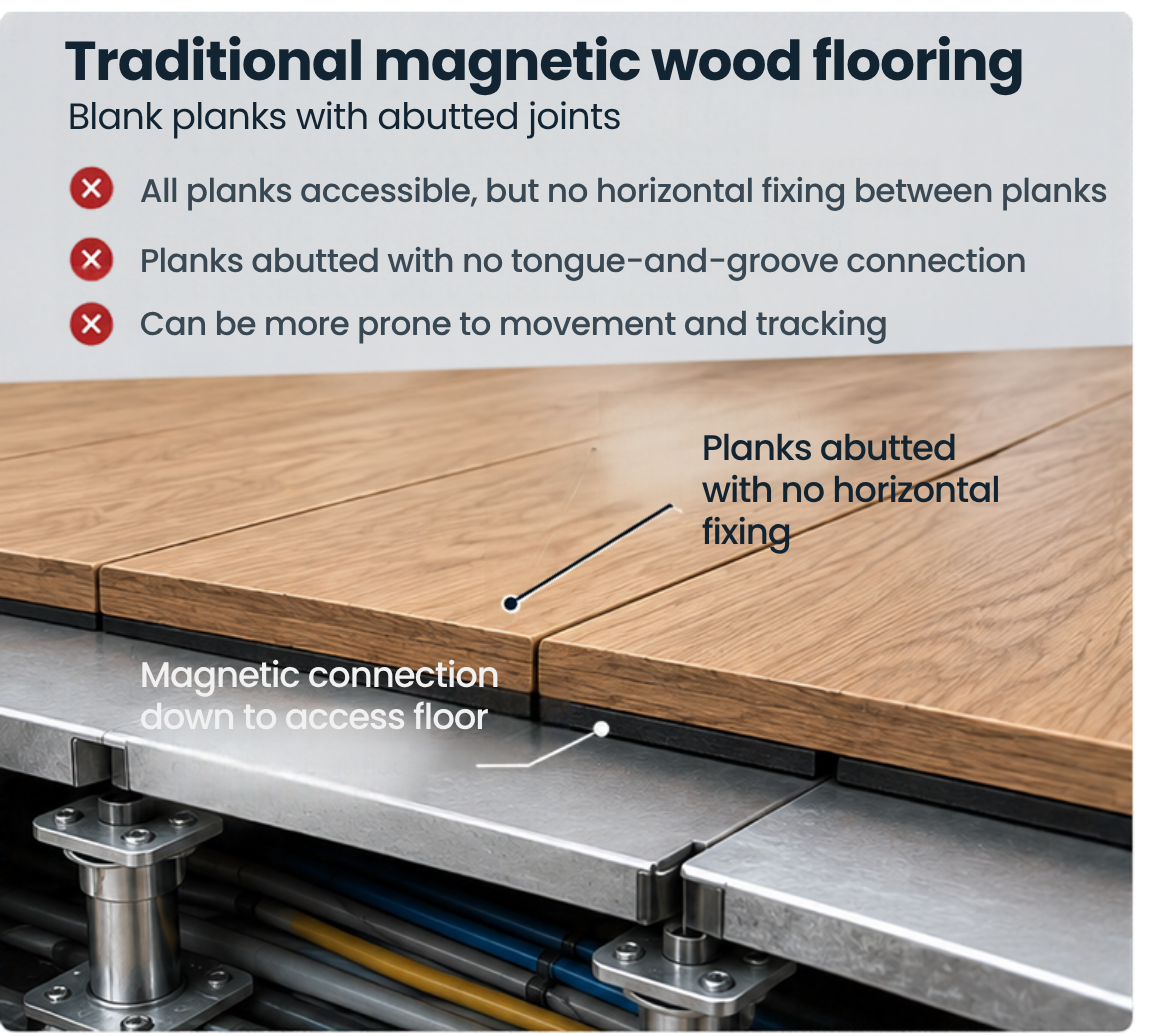
Generally, wood flooring manufacturers will pre-machine planks at their manufacturing site to create specialist magnetic access planks.
This involves modifying the profile of the magnetic planks so that all planks across the installation can be lifted independently to access the sub-floor.
These planks are fitted via abutted joints, resulting in a vertical attachment to the raised access floor through magnetism, but with no horizontal fixing between the planks themselves.
This can make the installation less stable and more prone to movement.
Benefits of access planks using CBS Magnetic Wood System
The CBS Magnetic Wood System employs a different method, whereby either CBS Magnetic Foil or CBS Magnetic Foil with Dual-Grip™ Technology is applied to the underneath of tongue-and-groove engineered wood flooring.
The engineered wood planks are connected horizontally using their interlocking tongue-and-groove profile.
This creates a secure connection between neighbouring planks whilst the magnetic system secures the flooring to the raised access floor beneath.
For applications requiring enhanced horizontal stability, CBS Magnetic Foil can also incorporate patented IOBAC Dual-Grip™ Technology.
This provides an additional dimension of hold between the magnetic wood flooring and sub-floor, helping to reduce movement and tracking
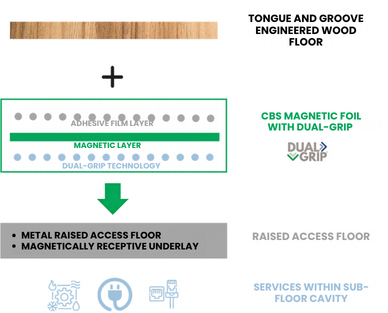

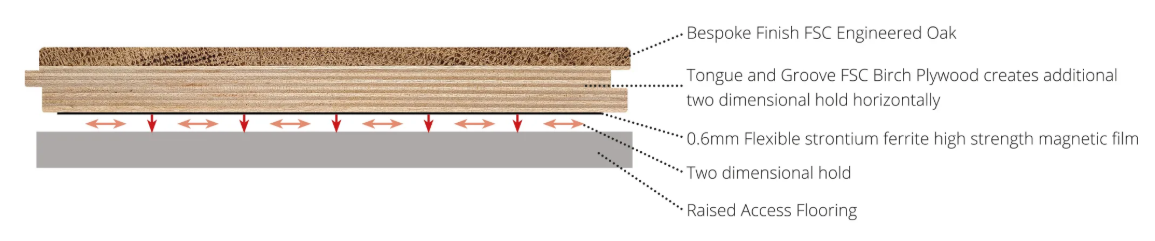
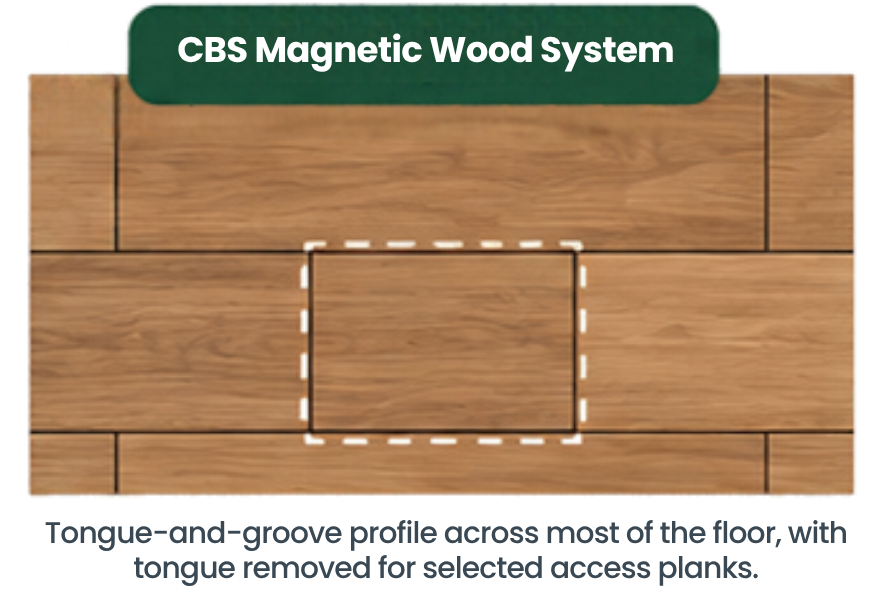
Profile of tongue-and-groove magnetic wood flooring using CBS Magnetic Wood System. Credit: WFA
Creating Access Planks: For areas where access is needed to the services beneath, selected planks are modified to create removable access points within the magnetic wood flooring installation.
Often called “critical access planks” or “blanks”, these planks can be easily lifted and replaced without having to first remove any surrounding planks.
At CBS, we have designed a flexible, on-site way to create critical access planks from standard tongue-and-groove boards. Using this simple modification means that the access plank retains a secure lap-join connection with its neighbouring planks, rather than relying on abutment alone.
The approach provides a practical way to create magnetic wood flooring access planks on site, reducing the need to stock specialist pre-machined access planks for every project.
It also maintains a more consistent and secure tongue-and-groove installation across the while floor with selected access planks able to be lifted independently using a suction cup when required.
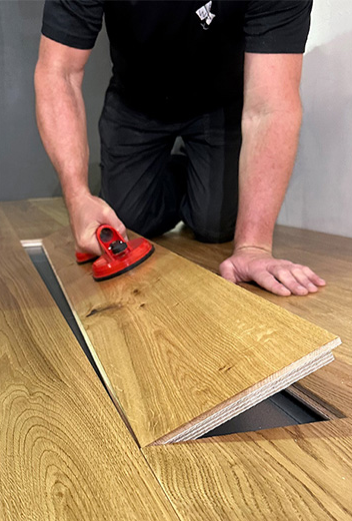
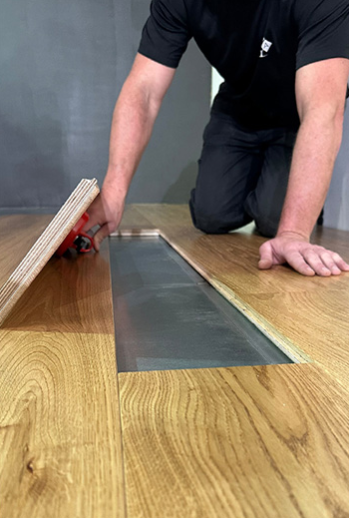
Tongue-and-groove magnetic flooring: combining security with access
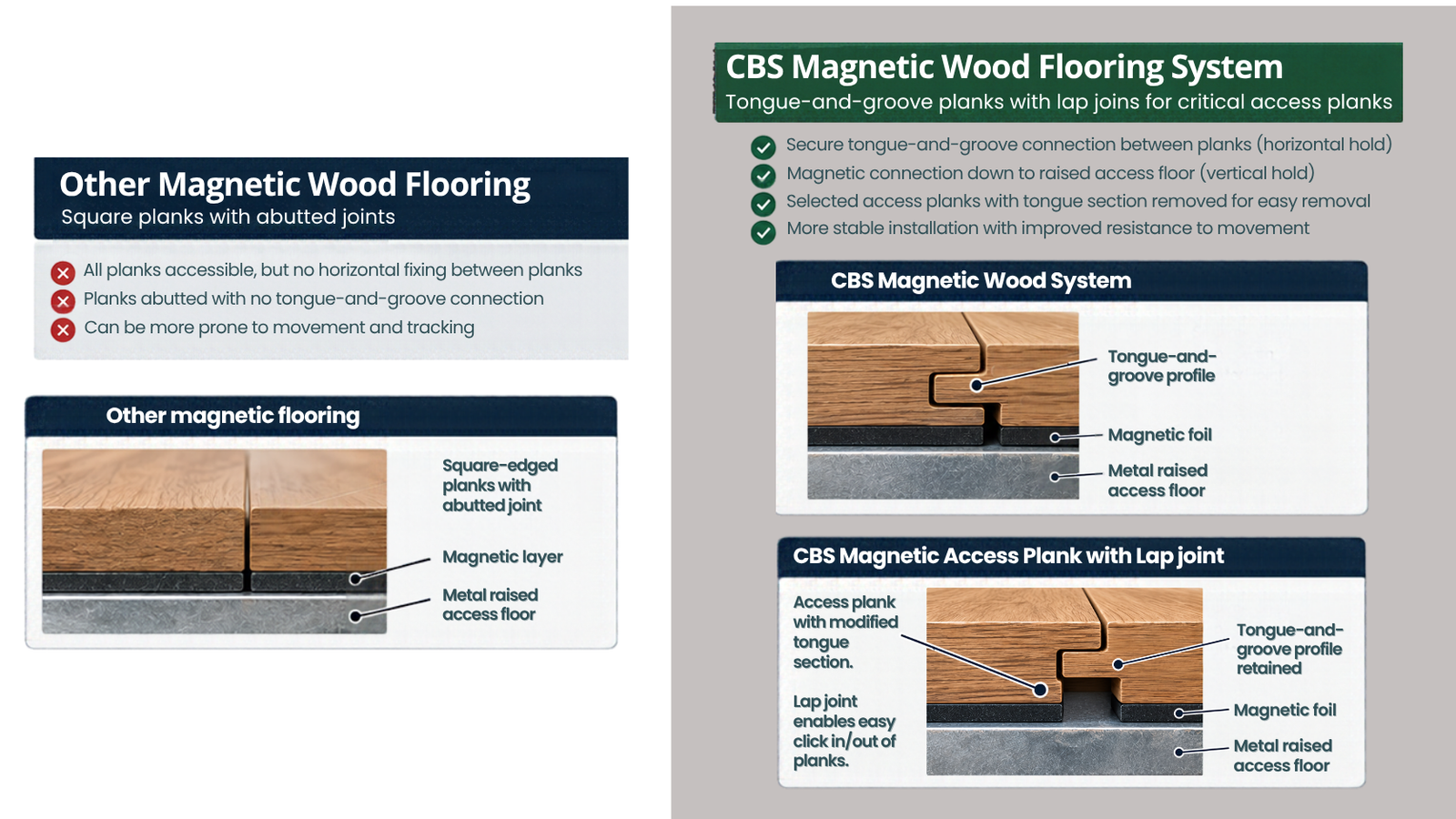
A key advantage of the CBS approach to magnetising wood flooring is that the tongue-and-groove profile is retained across the majority of the magnetic wood flooring installation, even for access planks.
The CBS Magnetic Wood System creates two separate connections:
Between the planks: The tongue-and-groove profile provides the horizontal interlocking connection between neighbouring engineered wood planks.
Between the flooring and sub-floor: CBS Magnetic Foil creates a reversible magnetic connection between the wood flooring and the magnetically receptive raised access floor.
The result is a system that combines the security of tongue-and-groove magnetic flooring with practical access to the floor void.
How are magnetic wood flooring access planks identified?
Creating removable access planks is only part of the solution. They also need to be easy to find.
CBS can advise on a simple UV identification system for critical access planks.
A discreet UV stamp is applied to the surface of the selected plank. The marking is invisible under normal lighting but can be located using an inexpensive UV lamp.
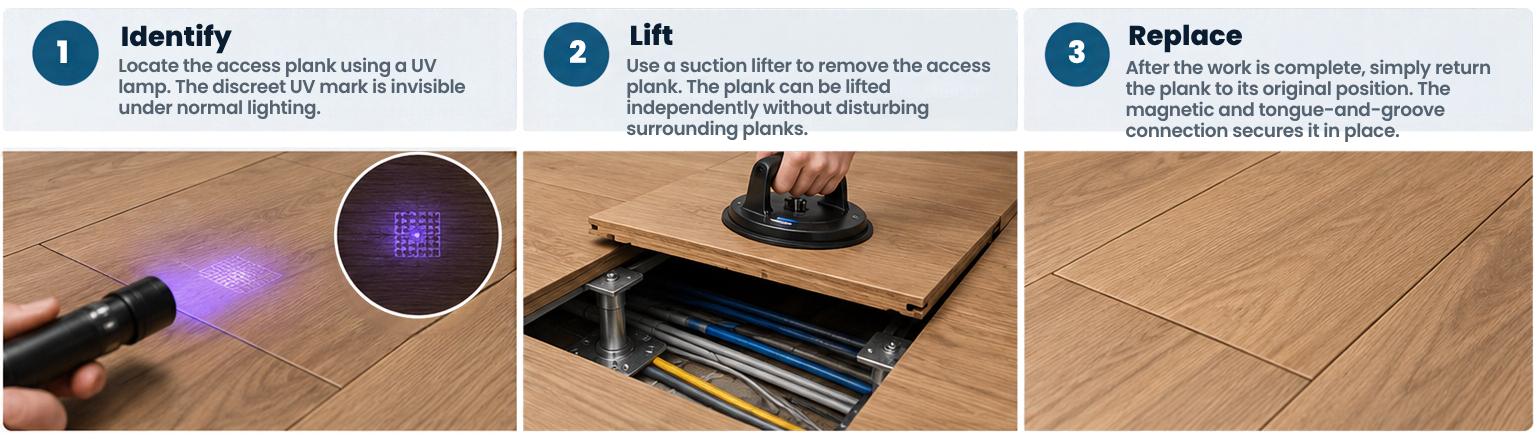
This means maintenance teams can identify the correct access plank without relying entirely on detailed floor plans or remembering where individual access points are located.
Once identified, the plank can be lifted using a suction cup to provide access to the floor void.
After the work has been completed, the plank can be returned to its original position.
It is a relatively small detail, but one that can make a significant difference to the practical maintenance of a commercial floor.
See the UV system in action at Broadleaf Timber
Why access to sub-floor services matters
The purpose of a raised access floor is to provide flexibility.
Commercial buildings frequently require changes to power, data, heating, ventilation and other building services as occupiers and workplace layouts change.
If the finished flooring makes access to those services difficult, the flexibility provided by the raised access floor is negated.
Magnetic wood flooring provides an opportunity to consider access as part of the flooring specification from the outset.
By identifying critical access points and incorporating removable access planks, the flooring can be designed around the future needs of the building.
This supports a more adaptable approach to commercial flooring installation, particularly where future refurbishment and changes to building services are anticipated.
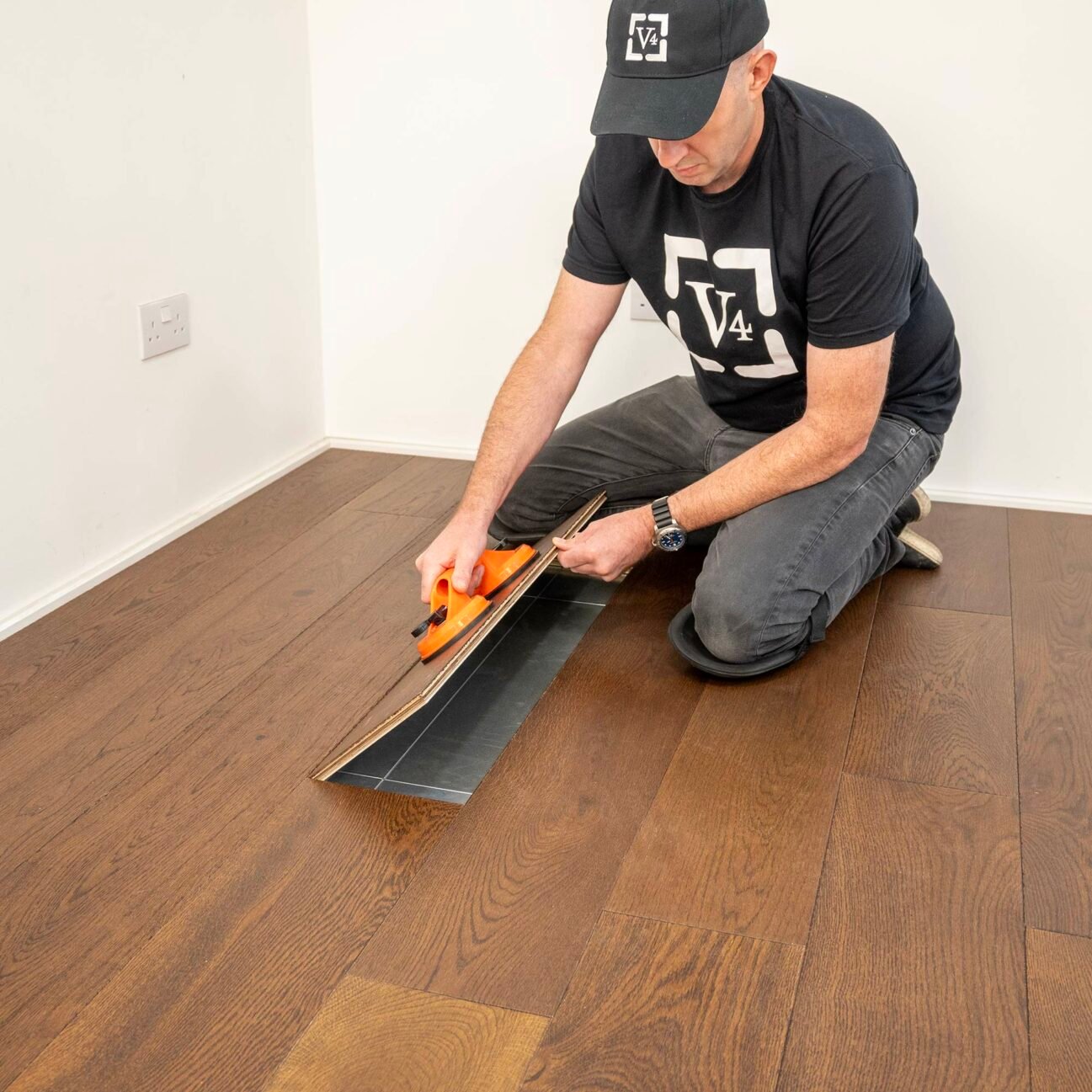
Credit: V4
Magnetic flooring installation for other floor coverings
The principle of using reversible magnetic installation is not limited to engineered wood flooring.
CBS also supplies IOBAC MagTabs®, which are designed to install carpet tiles, +4mm Luxury Vinyl Tiles and woven vinyl tiles onto magnetically receptive sub-floors such as metal raised access floors.
IOBAC MagTabs provide a secure connection whilst allowing the floor covering to be uplifted without permanently bonding it to the raised access floor and are used and/or approved by 16 major floor covering manufacturers.
IOBAC MagTabs were featured as a best practice case study in British Land’s Sustainability Brief for Office Fit-Out, where they were used on the 2 Kingdom Street project as a clean, reversible fixing for installing carpet tile and Luxury Vinyl tile onto raised access panels.
The brief identifies the damage from adhered plywood as a cause of raised access floor panels being discarded and discourages the use of chemical adhesives and permanent fixings that can compromise the future reuse of flooring and access floor panels.

Making access part of the flooring specification
Raised access floors provide an important layer of flexibility within commercial buildings.
The flooring installed above them should support that flexibility rather than make access more difficult.
CBS Magnetic Wood System provides one way to achieve this.
By combining a reversible magnetic connection with a retained tongue-and-groove profile, selected engineered wood planks can be designed for independent removal when access to raised floor services is required.
For architects, designers, flooring contractors and building owners, this provides an opportunity to consider access, maintenance and future reuse as part of the original flooring specification.
For wood flooring manufacturers, it also provides an opportunity to develop magnetic wood flooring products with practical access solutions built into the system.
Wood flooring manufacturers already using the CBS Magnetic Wood System include WFA, Broadleaf Timber and V4.








Comments are closed